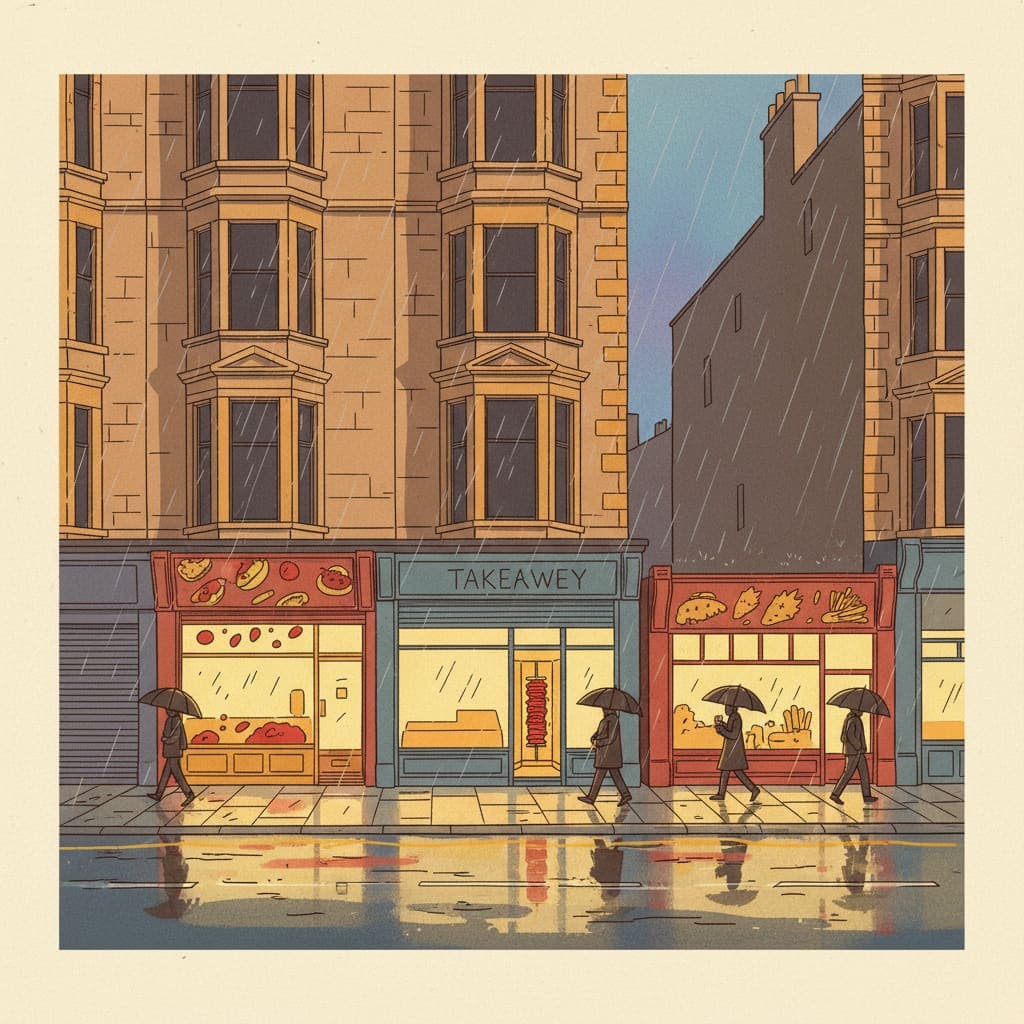
What's distinctive about Glasgow
Glasgow's restaurant economics differ from English cities in three ways that change the marketing playbook:
- Lower media costs. Google Ads CPCs for food terms in Glasgow typically sit at £0.90–£1.80, versus £3+ in central London and £1.50–£2.50 in Manchester. £15/day ad spend buys real volume here. Our Google Ads vs Just Eat comparison walks through the maths for budgets in this range.
- Stronger seasonality. Weather influences ordering behaviour more than further south. Winter delivery volume in G-postcodes can be 30–50% higher than summer for some cuisines. Campaigns and content should plan for this — promoting your warming dishes from October through February usually pays back.
- Dine-in is healthier than the UK average. Glasgow customers eat out comparatively often, especially in the West End, Merchant City, and the southside. Marketing that drives covers (not just delivery orders) is more important than in some English markets — review reputation and Instagram presence matter more than aggregator-platform optimisation for many G-postcode kitchens.
How Glasgow customers find restaurants
Patterns we see across kitchens we work with in G-postcodes:
Google Maps drives both delivery and dine-in discovery. A customer searching "best curry Glasgow", "biryani Pollokshields" or "halal restaurant Southside" sees the local pack first. Many established Glasgow restaurants have under-maintained Google Business Profiles, leaving the local pack genuinely contestable for kitchens that invest the modest weekly time to maintain theirs. Our guide on why your restaurant might not show on Google Maps covers the most common technical issues.
Instagram is heavily used for new-restaurant discovery in the West End and Southside. Younger customers in G3, G12 and the G41/G42 corridor will check a restaurant's Instagram before deciding — recent posts, recent stories, whether the place still feels alive. A profile that hasn't posted in eight weeks is a real silent killer. Our Instagram for restaurants guide is the starting point.
Old Firm and big match days at Hampden, Ibrox and Celtic Park shift demand inside a 2–3 mile radius. We pause or reweight campaigns on those days for clients in the relevant postcodes. If your Google Ads campaign just keeps spending on a Saturday afternoon when half your delivery zone is at the football, you're burning budget.
Reviews compound faster than in London. Lower competition density on review velocity means a steady review programme moves a Glasgow takeaway from 30 reviews to 150 in 12–18 months — visibly climbing the local pack. Our review-collection guide covers the safe, owner-run version.
Realistic ad budgets in Glasgow
- Most Glasgow takeaway zones work at £12–£18/day Google Ads spend. £400–£550/month produces 280–450 attributable clicks and roughly 18–28 attributable orders depending on landing page and offer.
- West End and city-centre dine-in restaurants typically need £20–£30/day for any meaningful share of voice on cuisine + neighbourhood search.
- For most G-postcode kitchens, a balanced split between organic SEO investment and modest ad spend outperforms either extreme — the local pack is genuinely contestable, but only if your GBP, photos and reviews have the foundations in place.
Postcodes we work in
- G41 / G42 (Pollokshields / Govanhill) — strong Pakistani / South Asian and growing Middle Eastern scene, very food-engaged customer base
- G43 (Shawlands) — fast-growing independent dine-in, strong Instagram pull
- G1 / G2 (City centre / Merchant City) — dine-in, lunch + evening focused, brand-led search matters
- G3 (Finnieston / West End edge) — Instagram-led brands, press and influencer coverage matter alongside SEO
- G12 (West End) — student + dine-in, mixed cuisines, term-time-sensitive demand
- G14 / G13 (Knightswood / Anniesland) — quieter suburbs, lower competition, GBP-led wins still very accessible
- G51 / G52 (Govan / Cardonald / Hillington) — delivery-heavy mixed-cuisine takeaways
- G31 / G32 (East End / Tollcross) — match-day-sensitive, mixed Pakistani / Polish / Turkish scene
What we typically work on for Glasgow kitchens
For most G-postcode takeaways and dine-in restaurants the highest-leverage starting point is Local SEO and an actively maintained Google Business Profile — Glasgow's local pack is genuinely contestable in a way it isn't in Manchester or London, and consistent weekly work tends to register fast. For West End and Southside dine-in spots, an Instagram-led social media programme typically does more work than paid, especially during student term-time. With CPCs as low as they are in G-postcodes, modest Google Ads on cuisine-specific search adds incremental orders cheaply once the foundations are in place.
What we don't promise
We don't promise specific revenue lifts or ranking positions. The Pollokshields takeaway and the Finnieston dine-in restaurant are essentially running different businesses — any agency claiming a guaranteed outcome across that range should be questioned.
What we do commit to: a written 90-day plan, monthly reporting, transparent pricing, and a clear pause or pivot if it isn't working by month four. If we look at your kitchen and think you'd benefit more from fixing one or two specific things yourself than from hiring us, we'll say so.