The numbers in this post are illustrative worked examples based on published platform commission rates and our own experience running campaigns for UK takeaways. Your specific numbers depend on cuisine, location, average ticket, ad-account quality and many other factors. We've cited official sources for everything that isn't ours; everything else is framed as "in our experience" or "we typically aim for" — never as a guarantee.
One important note up front: we're a marketing + web-design studio, not an online-ordering provider. We build beautiful, fast, SEO-optimised websites and we run Google + Meta ads, social and SEO. We don't replace Just Eat / Foodhub / Deliveroo as a channel. This post is about how to think about channel mix — not about leaving the apps behind.
If you run a UK takeaway, your largest marketing-related cost lines probably look like this:
- Just Eat / Deliveroo / Uber Eats commission. 14–35% of every order taken via the platform.
- Google Ads / Meta Ads. A monthly spend you control directly, paying to put your restaurant in front of locals searching or scrolling.
- Local SEO + Google Business Profile + social. Slower-burning but compounding — eventually free traffic.
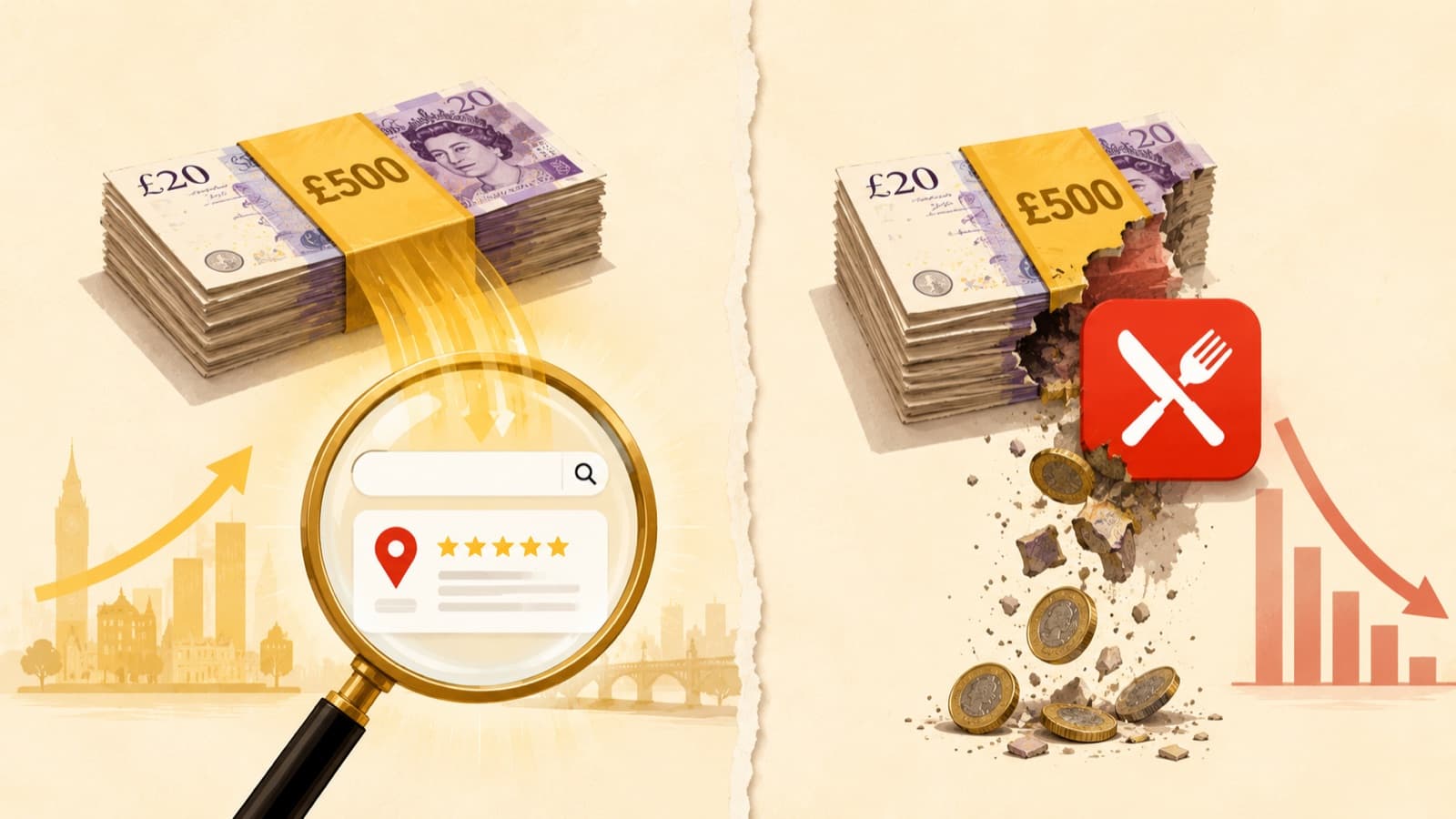
Most takeaway owners we meet think of platform commission as "the cost of being there" and treat ad spend as a separate, optional thing. The clearer way to think about both is customer acquisition cost per channel. Once you frame it like that, the question stops being "Should I be on Just Eat?" and becomes "What share of my next £500 should sit where?"
This post walks through the actual maths on a typical UK takeaway doing £15k/month online.
The Just Eat maths nobody does
Take a worked example: a takeaway doing £15,000/month through Just Eat.
- Gross order value: £15,000
- Just Eat commission: based on Just Eat's published rates,[1] commission ranges from around 14% (collection / order-only) to about 30% (full delivery). For a typical mixed-mode takeaway we'll use 20% as a working assumption = £3,000/month
- Effective customer-acquisition cost: £3,000 to acquire (and keep serving) those orders
- Per-order acquisition cost: if average ticket is £25, that's 600 orders. £3,000 ÷ 600 = £5 per order
That's the cost. Per order. Forever. Even on customers who order from you 50 times. Even on customers you yourself converted in your shop and then linked to the Just Eat app.
(Deliveroo[2] and Uber Eats[3] publish similar fee structures — the directional argument is the same.)
The Google Ads comparison
Now imagine the same takeaway spends £500/month on Google Ads.
- Spend: £500
- Cost per order: in our experience, a properly-optimised Google Ads account for a takeaway sits in the range £5–£10 in most UK areas after the first 4–6 weeks, varying with cuisine, postcode and ad account history. Let's use £7 as a working number for this example.
- Orders generated: roughly £500 ÷ £7 ≈ 70 orders/month at that cost
- Average ticket: £25
- Order value generated: ~£1,750
So far Google Ads looks broadly similar to Just Eat — around £7 to acquire each order. But here's where it diverges:
The lifetime difference
The Just Eat order has commission deducted every single time the customer orders through the app. Forever. A Google-Ads-acquired customer who later orders direct via your phone, your website or in person pays the £6 acquisition cost once — every reorder after that pays you full retail price.
If a customer first finds you via Google Ads and then orders 5 more times direct (by phone, in person, or via your own website if you offer ordering on it):
- All-via-Just Eat lifetime: 6 orders × £25 = £150, with 20% commission = £120 net to you
- Mixed lifetime (Ads + direct reorders): £7 one-time acquisition + 6 × £25 = £150 − £7 = £143 net to you
That's roughly £23 of extra margin per customer, every customer who reorders direct after their first visit.
The exact figure depends on reorder rate, ticket size, how aggressive the platform commission is, and how good your direct-channel experience is (your website, your phone team, your actual restaurant). But the direction is consistent: once you've paid to acquire a customer once, every subsequent direct interaction earns full margin.
This is why we'd nudge most takeaways towards a mix — keep the platforms for new-customer discovery, and invest seriously in your own brand (a fast, beautiful website, strong Google presence, social) so the same customer doesn't always come back through the most expensive channel.
The honest caveats
The maths above assumes:
- You have a website Google Ads can actually send people to. Slow site, missing menu, no booking form? Most of that ad budget evaporates on bounces. We build beautiful, fast websites with proper Google-optimised landing pages — and if you want online ordering on top, we make sure the site plugs into your chosen ordering partner cleanly.
- You have decent conversion rate. Most independent takeaway sites convert at 2–4% on Google Ads traffic. Below 2%, you're losing money on Ads. The fix is usually photography + faster checkout.
- You don't double-count. Some diners who would have come via Just Eat anyway will switch to direct once they know the option exists. We typically see 20–30% of "ad-acquired" diners are partially cannibalised — meaning the true incremental margin is around 70–80% of the headline number. Still meaningful.
- Your area has search volume. In a small market town with 200 weekly "near me" searches, £500/month on Google Ads will not work. We'll tell you in the audit.
"But Just Eat brings new customers I'd never reach"
True — which is why we don't recommend leaving Just Eat. The platform is a new customer acquisition channel with its own discovery surface; lots of diners try a new restaurant for the first time because it appeared on the app. The mistake is treating Just Eat as your only channel and never building the assets that catch the same diner the second, third or tenth time they want food from you.
A healthier channel mix for most independent takeaways looks something more like:
- Just Eat / Deliveroo / Uber Eats — for new-customer discovery (worth the commission on first orders).
- Beautiful, SEO-optimised website + Google Business Profile — so when those new diners later search for you by name, or when locals search "biryani near me", you actually show up.
- Google Ads + Meta Ads + social — paid amplification of the brand you've now built, targeted to the right radius and the right moment.
- Local SEO — the slow-burn channel that compounds and eventually delivers free traffic for years.
A common rule of thumb we suggest is something like 40% platform / 60% direct marketing — vs the heavily platform-dominant mix (often 90%+ platform) we typically see when auditing independents. Don't take that ratio as gospel; it's a starting point for conversation.
What to do this week
If you're spending £3k/month on Just Eat commission and £0 on marketing of any kind, you have a margin problem masquerading as a revenue problem. The first £500/month of direct marketing spend — a fast website, decent Google Business Profile, light ad spend, basic social — typically earns back faster than almost any other investment in your business.
You don't have to take our word for it. Run the maths on your own numbers — happy to walk through them with you.
Or just keep paying 20% to Just Eat forever and never build a brand of your own. That works too.
Sources & further reading
We help UK restaurants and takeaways grow online. Get in touch for a free audit.