Which one would you order from?
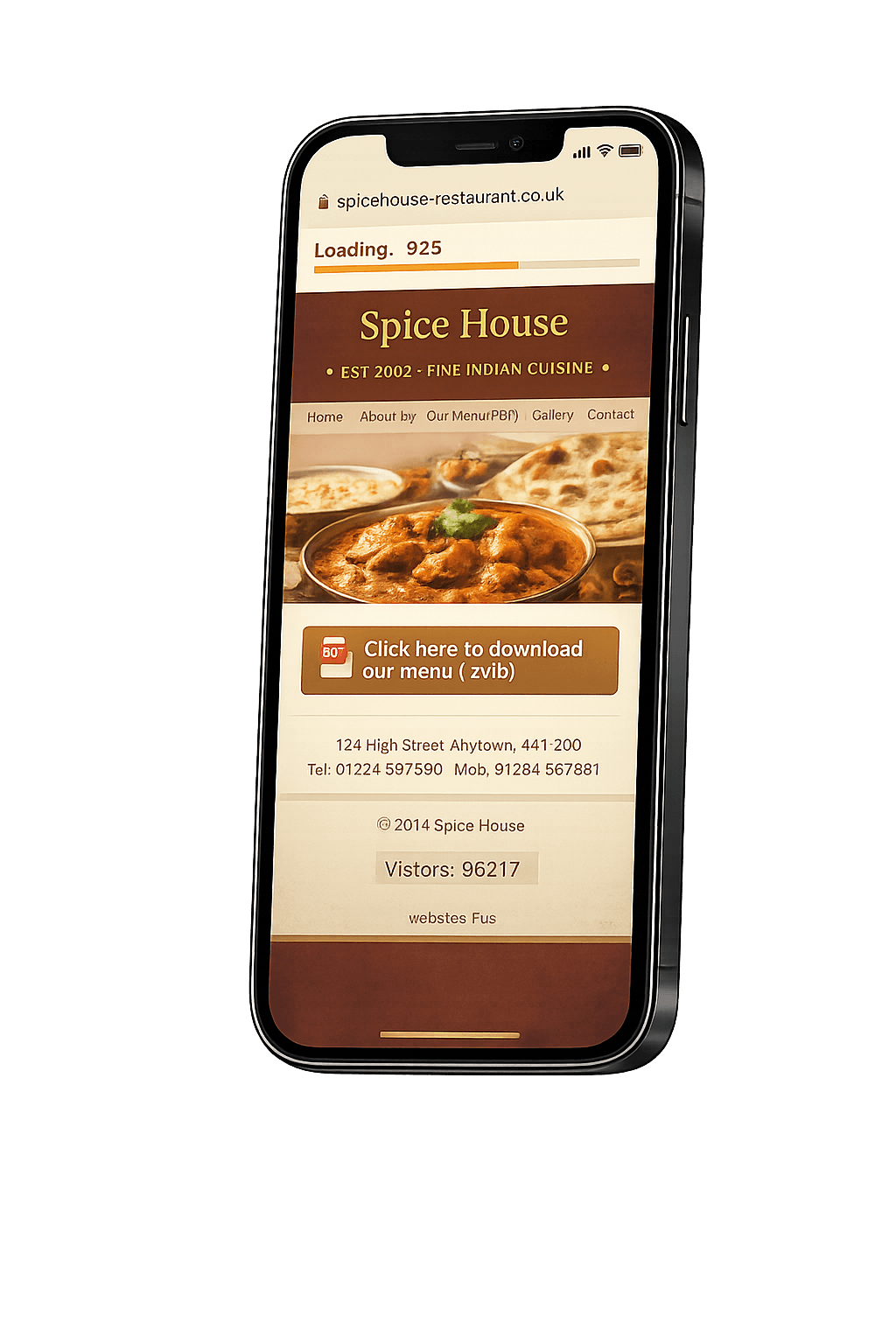
- ✗Menu is a PDF nobody opens
- ✗Slow to load on a phone
- ✗Looks dated — like every old site
- ✗No way to order or call in one tap
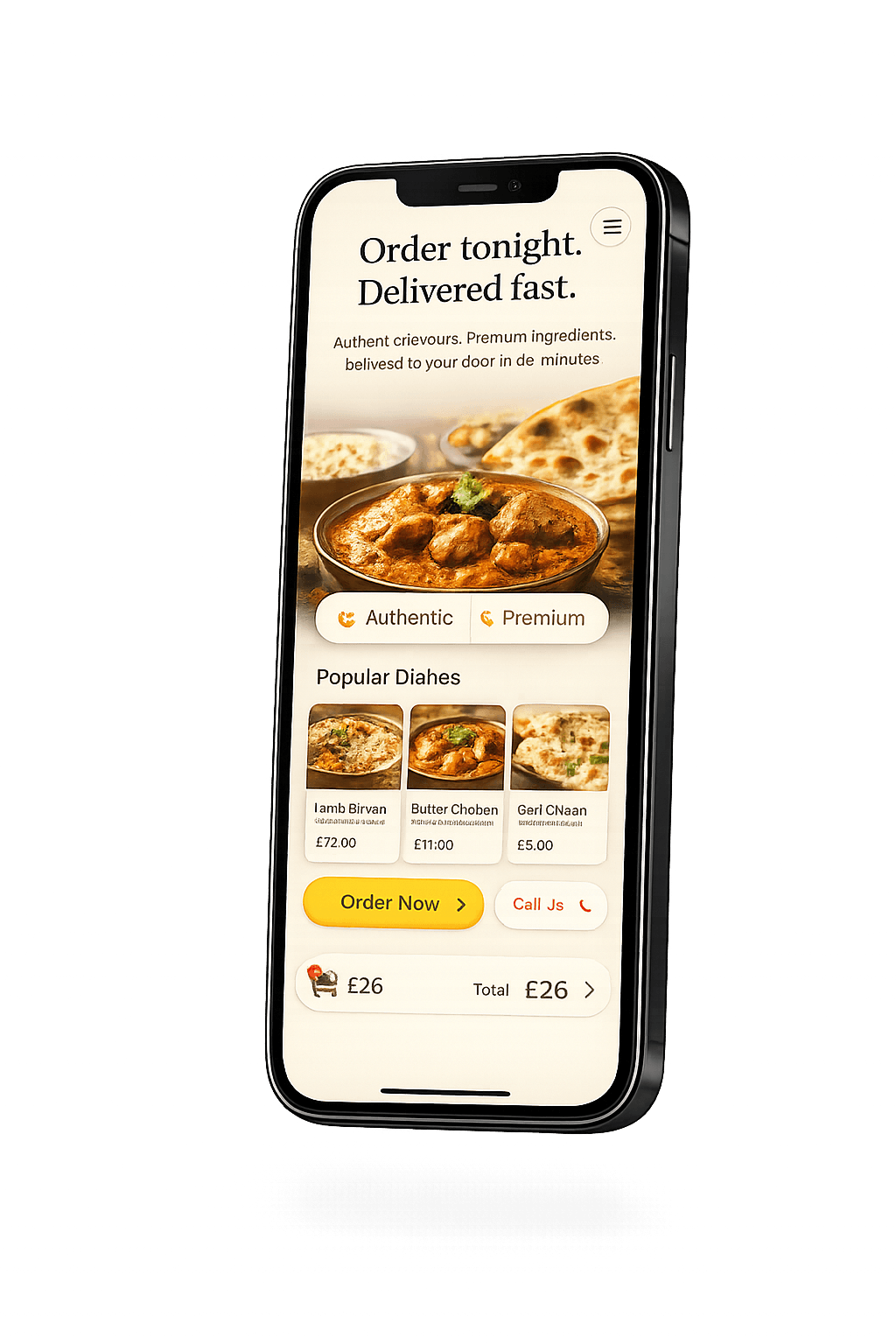
- ✓Live menu — Google can read it
- ✓One tap to order, one tap to call
- ✓Designed around your brand
- ✓Looks modern. Stays modern.
What makes a restaurant website "good" in 2026?
A good restaurant website is fast, mobile-first, brand-distinct and machine-readable. Fast means the page paints in under 2.5 seconds on a mid-range phone over 4G. Mobile-first means designed for a thumb on a 6-inch screen, not scaled down from a desktop comp. Brand-distinct means it does not look like 12 other curry houses with the same WordPress theme. Machine-readable means the menu, hours, address and dietary tags are wired into structured data Google and AI engines can lift directly.
Six things, no fluff.
- Custom design
Yours alone — no templates
- Mobile-first
Built for the back of an Uber
- Found on Google
Local SEO baked in
- Live menu
Edit prices in seconds
- Fast hosting
Served from Vercel's edge
- 1 year of edits
Free, no extra cost
How does Google rank restaurant websites?
Google ranks restaurant websites on three layered signals: technical health (Core Web Vitals — loading speed, interactivity, layout stability), content depth (real menu pages, real photos, real local content — not a single PDF), and topical authority (links from local press, citations from Google Business Profile and Bing Places, schema that names your cuisines and dietary tags). Sites that score on all three rank in the top results. Sites that score on one rarely make the first page.
Custom build vs DIY platforms vs no website — what's different?
A custom-built site is fast, owned by you, and tuned for Google. A Wix or Squarespace site is templated, slower on average, and limited in how deeply you can wire structured data. Going without a site at all and relying on Just Eat means a marketplace owns the customer and charges 14–30% commission per order. Each path has a place — for a serious independent restaurant, the custom build pays for itself once it starts compounding rankings.
| Approach | Speed (Lighthouse) | SEO control | Brand feel | Customer relationship |
|---|---|---|---|---|
| Custom build (Manto) | 90+ | Full | Premium, unique | Yours |
| Wix / Squarespace | 60–75 | Limited | Templated | Yours |
| Just Eat only, no site | N/A | None | Marketplace | Theirs |
Three specialisms we build for
Most websites are roughly the same job. These three aren't.
Rank #1 for “near me” in your postcode.
One brand. Top of Google for your postcode.
One brand. Every branch ranks.
Each branch ranks in its own postcode. One brand.
Calories. Allergens. Filters that work.
Calories, allergens, filters that work. Try them →
Example menu — illustrative.
- Grilled chicken bowl£11480 kcalgluten freehalalP42gC38gF14g
- Paneer tikka wrap£9620 kcalvegetarianP26gC58gF22g
- Lamb seekh kebab£12540 kcalgluten freehalalP38gC12gF32g
- Veg biryani£10720 kcalvegetarianP18gC96gF18g
One website. Five languages.
Real translations, proper RTL for اردو and العربية — not a Google Translate widget bolted on at the end. Tap a language to see the live menu switch.
Will my website rank in ChatGPT and AI search?
Yes — but only if it's structured so AI engines can extract the parts that matter. ChatGPT search, Perplexity, Gemini and Google AI Overviews all rely on the same machine-readable signals: Restaurant schema with menu and dietary tags, an /llms.txt manifest, fresh page modification dates, and entity anchors back to Google Business Profile and Wikidata. We ship every site with these wired in by default, so the AI-citation work is done at launch rather than as a retrofit.